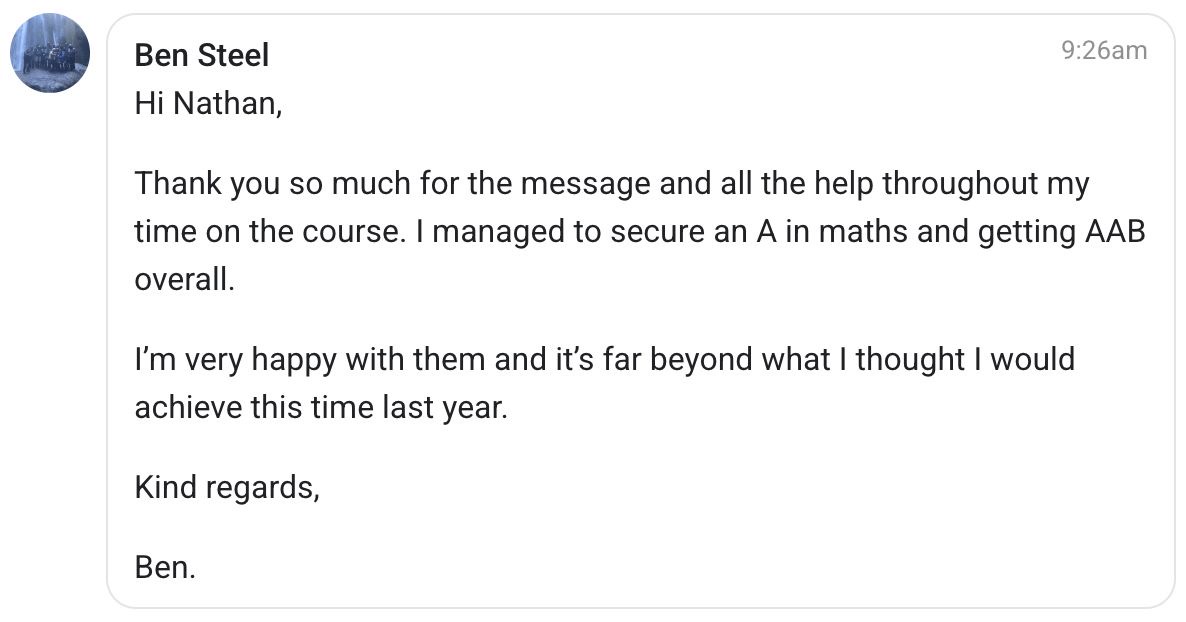
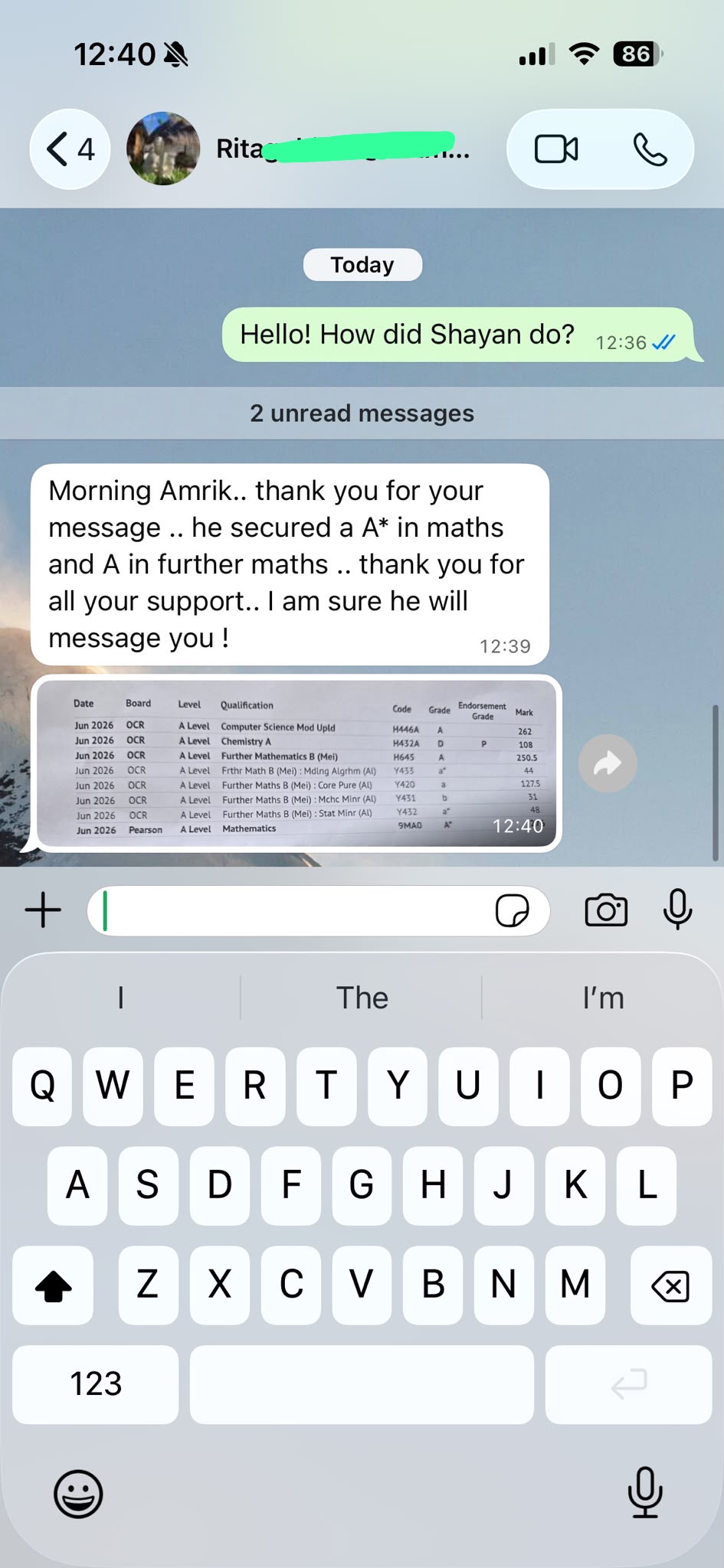
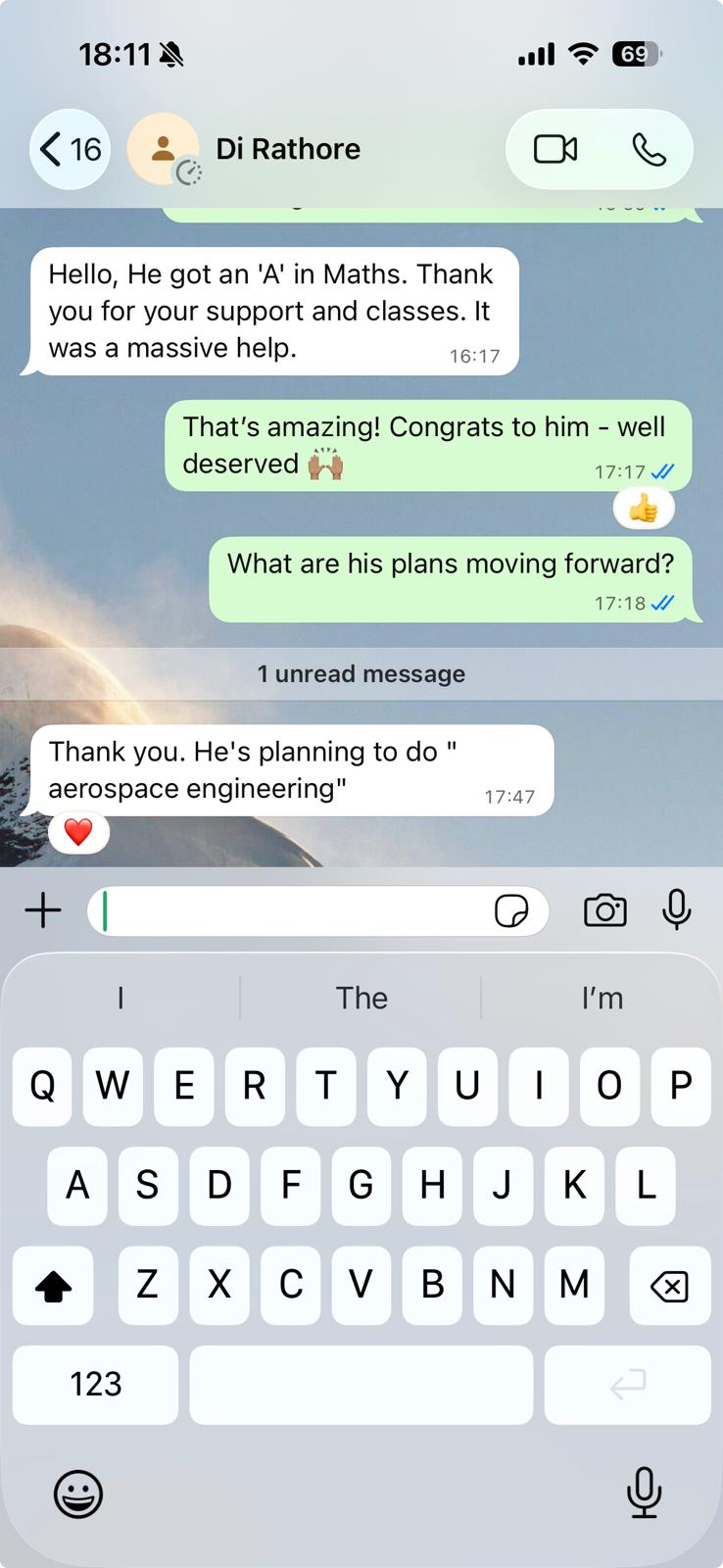
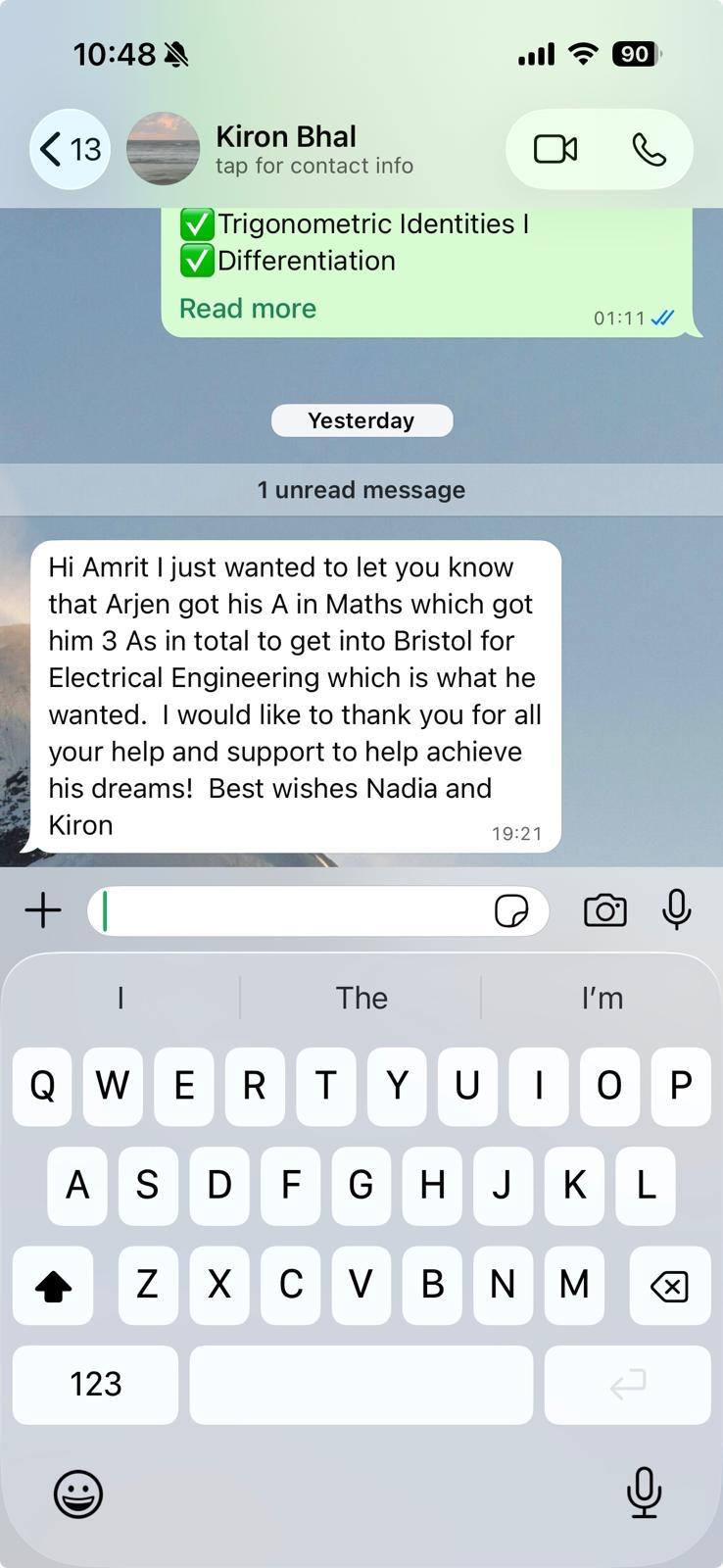
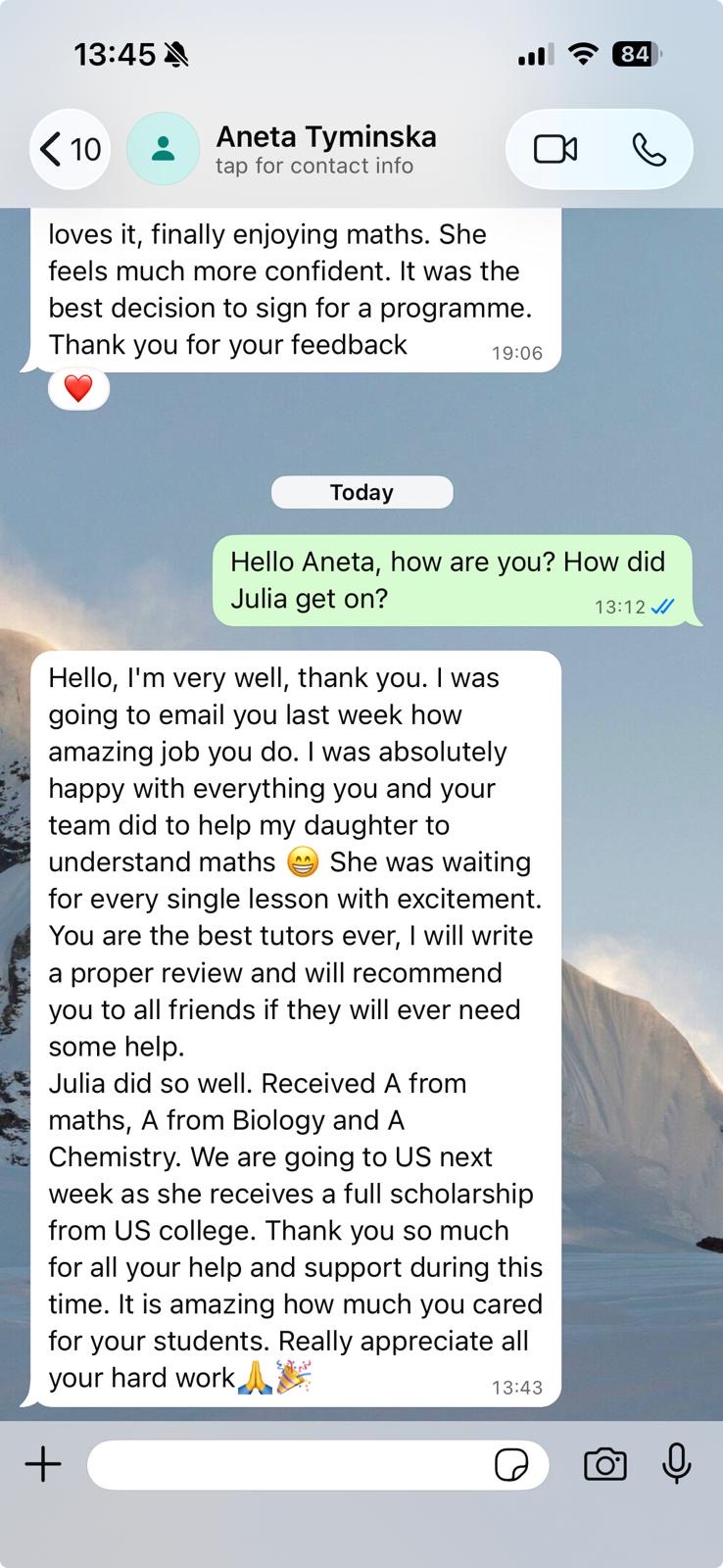
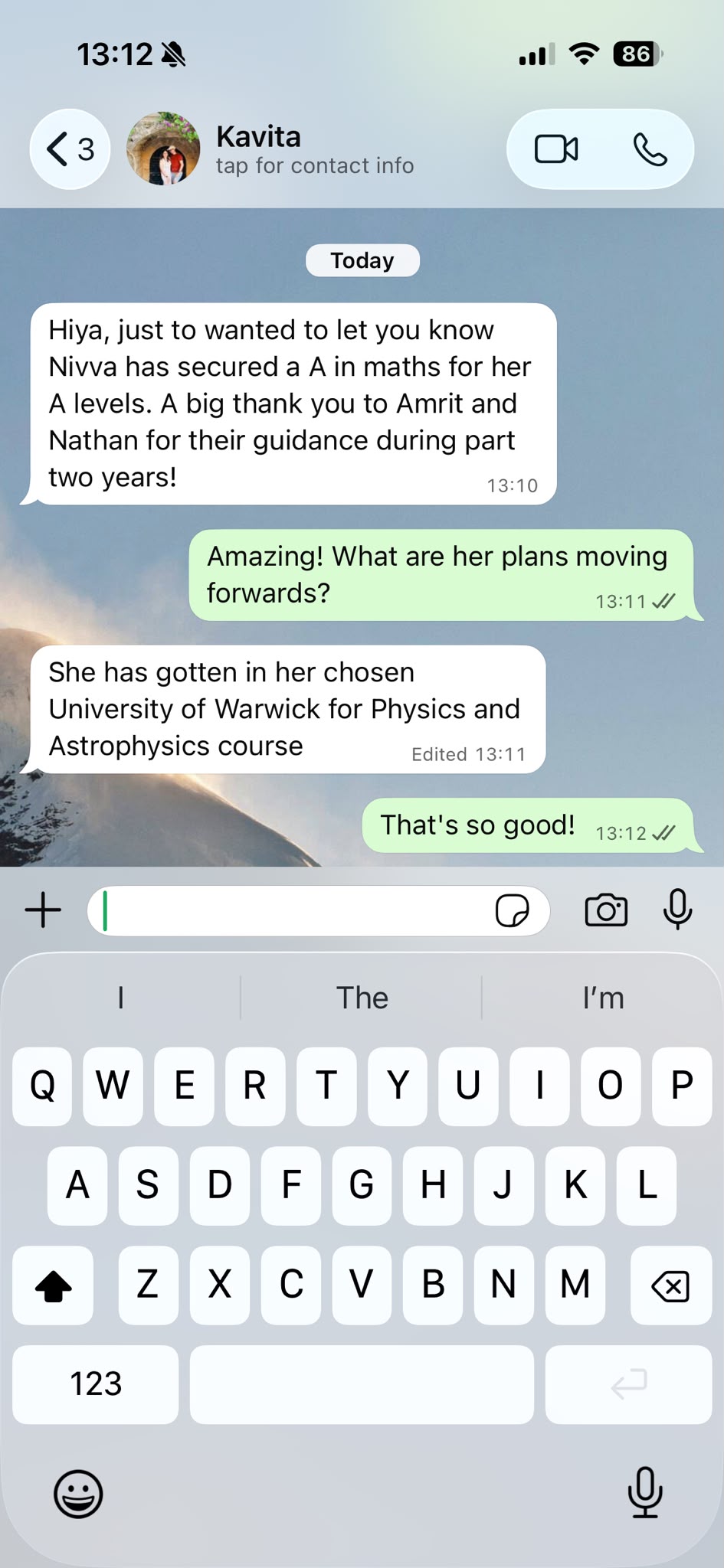
Next Intake Starts 1st September 2026
Join now and attend our summer classes at no additional cost.
Before Watching The Full Program Walkthrough, Understand Why Capable Students Underperform
This 20-minute introduction explains why capable students struggle in A-Level Maths, why school alone is no longer enough, and why our students consistently outperform their peers.
If you're serious about helping your child achieve an A/A*, I strongly recommend watching this before continuing
This program runs in structured cohorts.
Summer Program is now underway.
Join now to receive support through to June 2027.
Prefer reading instead? (4-5 mins)
Everything covered in the video is written below. Read through it at your own pace before continuing.
Scroll down to continue.
Read this first before watching the full program walkthrough
A-Level Maths Mastery exists for one reason.
To fix the broken system that leaves capable students confused, overwhelmed, inconsistent, and underperforming in A-Level Maths and Further Maths.
Most students who struggle with A-Level Maths are not weak at maths.
They are not incapable.
They are not “just not maths people.”
In many cases, they are bright, capable students who did well at GCSE, started Year 12 with confidence, and then suddenly found themselves losing marks, falling behind, or feeling like the subject no longer makes sense.
Parents come to us because something is clearly not working.
Their child may be working hard, attending school, watching YouTube, using the textbook, and maybe even seeing a tutor…
…but the marks are still not where they need to be.
This page will help you understand why that happens.
It will also help you decide whether A-Level Maths Mastery is the right fit for your family.
If it is, the full program walkthrough will show you exactly how our system works.
If it isn’t, no further action is needed.
The uncomfortable truth about A-Level Maths
A-Level Maths is not GCSE Maths with harder numbers.
It is a completely different level of thinking.
At GCSE, many bright students can do well by memorising methods, practising familiar question types, and working hard close to the exam.
At A-Level, that approach starts to break down.
Modern A-Level Maths questions now require students to:
- understand topics deeply
- recognise hidden patterns
- connect multiple chapters together
- apply methods in unfamiliar situations
- work quickly under pressure
- avoid small errors across long solutions
- explain reasoning clearly
- handle questions they have never seen before
This is why so many students say:
“I understand it in class, but I can’t do the exam questions.”
That sentence is one of the biggest warning signs in A-Level Maths.
It usually means the student has understood the basic version of the topic, but not to the depth required for the real exam.
And if a student truly understood the content to the level required for an A or A*, they would not consistently be scoring 50%, 60%, or even low 70s.
They would be much closer to 85–90% because they would know how to handle the harder, unfamiliar, mixed-topic questions.
That is the real gap.
Not intelligence.
Depth.
Who this program is for
A-Level Maths Mastery is designed for a very specific type of student and family.
This program is for:
- Year 12 or Year 13 students aiming for an A or A* in Maths or Further Maths
- Students who are capable but currently underperforming
- Students who did well at GCSE but are finding A-Level Maths much harder than expected
- Students who want clarity, structure, accountability, and expert teaching
- Students who are willing to complete homework and practise properly
- Students who want to be taught from the basics all the way to the hardest exam questions
- Families who want a structured long-term system, not random weekly tutoring
- Parents who value discipline, consistency, responsibility, and long-term outcomes
- Parents who want their child to be properly prepared before Year 13 pressure builds
- Families who want support from mathematicians, qualified teachers, and examiners
- Students who are willing to ask for help when they are stuck
This is for families who are not looking for shortcuts.
They want the right system.
They want proper support.
They want their child to take responsibility.
And they want to know that everything is being done properly.
Who this program is not for
This program is not for everyone.
It is not for:
- students who refuse to do homework
- students who sit silently when they are stuck
- students who avoid difficult questions
- students who only want to do easy textbook exercises
- students who expect results without consistent effort
- students who want to cram at the last minute
- parents looking for cheap hourly tuition
- families who want a tutor to “just fill gaps” without a full system
- students who ignore feedback and repeat the same mistakes
- students who say “I understand” but cannot do questions independently
- students who will not use the help available to them
- parents who want last-minute rescue support just before exams
No program can outperform a student who refuses to engage.
No teacher can force a student to care.
No tutor can do the maths for them.
A-Level Maths Mastery works when the student follows the process.
If your child is willing to work, ask questions, use the support, complete the homework, and take responsibility, we can help them make serious progress.
If they are not willing to do that, this will not work.
This will not work if nothing changes
If your child continues doing the same things, they should not expect different results.
This will not work if your child:
- attends lessons but stays silent when confused
- gets stuck and does nothing about it
- does not ask questions
- does not send work for feedback
- does not use message support
- does not attend help sessions
- skips homework
- ignores feedback
- avoids the hardest questions
- only practises topics they already like
- watches videos but does not practise independently
- refuses timed papers
- relies on last-minute cramming
- blames the school, the exam board, or the situation without changing their own behaviour
- spends hours on their phone every day but says they have no time for maths
If you recognise these patterns and nothing changes, the result is unlikely to change either.
A-Level Maths rewards disciplined students.
Not perfect students.
Disciplined students.
The ones who turn up, do the work, ask for help, correct their mistakes, and keep going.
That is the type of student we want to work with.
Why most capable students still struggle
Most students who underperform in A-Level Maths are not struggling because they lack ability.
They are struggling because they have not been taught A-Level Maths to the depth now required.
Schools have an extremely difficult job.
Teachers have limited time, large classes, a huge specification to complete, internal assessments, predicted grades, admin pressure, and students of mixed ability in the same room.
Because of that, many schools end up focusing on one thing:
getting through the content.
But getting through the content is not the same as mastering the content.
A student can complete a chapter in school and still not be exam-ready.
A student can understand the examples in class and still be unable to handle the real exam questions.
A student can finish the textbook exercise and still be nowhere near A/A* standard.
This is the problem.
Many schools:
- rush through content because they have to finish the syllabus
- assume foundations are secure when they are not
- teach basic textbook examples but not enough difficult exam-style variations
- do not revisit chapters in enough depth
- do not spend enough time on the hardest A* questions
- do not connect topics together the way real exam papers do
- leave students to figure out harder questions independently
- run revision sessions where students are just doing questions alone
- offer intervention that is too general and not specific enough to the student’s gaps
This does not mean the school is bad.
It means the system is stretched.
And in A-Level Maths, a stretched system creates quiet gaps.
Those gaps compound.
Then the student opens a mock paper and suddenly realises they cannot do half the questions.
Top schools often assume too much
This is especially common in selective schools, grammar schools, independent schools, and high-performing sixth forms.
Because the average student is strong, the pace is often even faster.
Teachers may assume students already know more than they actually do.
The class moves quickly.
Questions get skipped.
The harder examples are left for independent work.
And students who were previously top performers start to feel embarrassed because everyone around them seems to be coping.
So they stay quiet.
They do not ask questions.
They tell their parents:
“It’s fine.”
But then the assessment result tells a different story.
A student can be in an excellent school and still not be receiving the depth, repetition, feedback, and exam exposure required to reach an A or A*.
School is important.
But for many students, school alone is not enough.
Your child is probably not being taught A-Level Maths in enough depth
This is the key issue.
A-Level Maths cannot be learned properly by seeing one or two examples and then doing a textbook exercise.
That might create familiarity.
It does not create mastery.
To reach the top grades, your child needs to be taught every topic in layers.
First, they need to understand the core idea.
Then they need to see the standard question types.
Then they need to see the harder variations.
Then they need to see how the topic appears across different exam boards.
Then they need to practise mixed-topic questions.
Then they need to work under timed conditions.
Then they need feedback on where marks are being lost.
Most students never receive that full progression.
So they end up with false confidence.
They can do the basic version.
They can copy a method.
They can follow a worked example.
But when the exam question is worded differently, or when three topics are mixed together, they freeze.
That is not a silly mistake.
That is a depth problem.
“Silly mistakes” are rarely the real issue
Parents often tell us:
“They know the content. They just make silly mistakes.”
Sometimes that is true.
But if a student is losing 30%, 40%, or 50% of the paper, that is not just silly mistakes.
A silly mistake is dropping a minus sign.
A silly mistake is copying a number incorrectly.
A silly mistake is forgetting to round properly.
But losing half the marks usually means something deeper is happening.
It means the student:
- does not fully understand the content
- cannot recognise what the question is asking
- cannot connect topics together
- does not know which method to use
- runs out of time
- panics under pressure
- has not seen enough variations
- has not practised at the required level
A student aiming for A or A* cannot afford to rely on “I understand most of it.”
They need control.
They need to know exactly what to do when the question looks unfamiliar.
That level of confidence does not come from hope.
It comes from structured training.
Textbooks are not enough

Most students are still relying heavily on the main A-Level Maths textbooks used in schools.
The problem is that these textbooks were created around the current specification, which began in 2017.
The specification may not have changed dramatically.
But the style of exam questions has.
Modern papers now include more unfamiliar wording, more modelling, more reasoning, and more mixed-topic application.
Textbooks are useful for introducing a topic.
They are not enough to produce an A*.
Doing textbook questions is often very basic compared to the real exam.
A student may finish an exercise and feel confident because they can do ten questions that all look similar.
Then the exam asks the same idea in a completely different way.
That is where marks are lost.
The textbook teaches the topic.
The exam tests whether the student can think.
There is a big difference.
YouTube is not enough either
YouTube can be helpful.
But YouTube is not a structured A-Level Maths system.
Most videos explain one method, one example, or one question.
They do not know your child’s gaps.
They do not mark your child’s work.
They do not build a study plan.
They do not force your child to practise.
They do not hold them accountable.
They do not check whether they can apply the topic under pressure.
That is why students often say:
“I watched the video and it made sense.”
But then they still cannot do the exam question independently.
Watching someone else do maths is not the same as being able to do it yourself.
Your child needs to learn, practise, struggle, ask questions, get feedback, correct mistakes, and repeat the process until the topic is secure.
That cannot happen through random videos alone.
Hard work is not enough if the system is wrong
Some students genuinely work hard.
They spend hours revising.
They highlight notes.
They watch videos.
They redo textbook questions.
They try past papers.
But their marks still do not move.
That is incredibly frustrating for both the student and the parent.
The reason is simple:
hard work only works when it is directed properly.
If your child spends ten hours practising easy questions, they become good at easy questions.
If they spend ten hours watching videos without attempting enough questions, they become good at watching videos.
If they spend ten hours doing random past papers without fixing the underlying gaps, they become ten hours more frustrated.
A-Level Maths progress comes from doing the right work in the right order.
The student needs:
- clear teaching
- structured progression
- difficult questions
- exam-board specific practice
- mixed-topic exposure
- regular homework
- marked assessments
- feedback
- accountability
- help when stuck
Effort matters.
But effort without the right system is unreliable.
Your child may not be trying hard enough
This is not always easy to say.
But it is important.
Many students want A or A* results without yet behaving like A or A* students.
They want the grade.
They want the university place.
They want the future opportunity.
But their weekly routine does not match the outcome they say they want.
A-Level Maths requires consistent independent study.
For most students aiming for an A or A*, that means around 10 hours per week for Maths.
For students doing Further Maths as well, it may need to be more.
That does not mean studying all day.
It means studying consistently.
Around 90 minutes a day, done properly, can completely change a student’s trajectory.
But if a student is only doing one or two hours a week outside school, avoiding difficult questions, and cramming before assessments, they are not preparing like a top-grade student.
That has to change.
The phone conversation parents need to have

Before deciding your child does not have time for more maths, ask one question:
“What was your screen time last week?”
Many students spend 20, 30, or even 40 hours per week on their phone.
Scrolling.
TikTok.
YouTube.
Messages.
Gaming.
Distraction.
We are not saying students cannot relax.
We are not saying they should have no social life.
But if a student is spending 30 hours a week on their phone and only 3 hours a week on independent maths, the maths is not going to improve quickly enough.
Time is rarely the real problem.
Structure is.
Priorities are.
The goal is not simply to “study more.”
The goal is to spend less time distracted and more time doing maths properly, using the right system, with the right support.
That is how progress happens.
Grade boundaries are higher than most families realise
The standard required for A and A* is now extremely high.
Students cannot rely on the idea that “the grade boundaries will be low.”
They cannot rely on doing well on the easier questions and hoping that is enough.
They cannot rely on partial understanding.
In many recent papers, students need a very high level of accuracy to secure the top grades.
That means every mark matters.
A few weak topics can cost an entire grade.
Poor timing can cost an entire grade.
Not knowing how to approach the final questions can cost an entire grade.
Weak mechanics, weak statistics, weak integration, weak trigonometry, weak vectors, weak proof, weak modelling — these are not small issues.
They are grade-deciding issues.
The margin for error is smaller than parents expect.
That is why your child needs to be trained to a much higher standard than “I mostly understand it.”
They need to be exam-ready.
Competition is higher than ever
Your child is not only competing with students in their school.
They are competing with ambitious students across the country and internationally.
Students applying for medicine, dentistry, economics, engineering, computer science, finance, maths, physics, architecture, law, PPE, and competitive degree apprenticeships are often preparing very seriously.
Many have specialist support.
Many are doing extra lessons.
Many are completing additional exam questions every week.
Many are finishing the syllabus early.
Many are using the summer to get ahead.
Many are preparing like athletes.
That does not mean your child cannot compete.
It means they need to prepare properly.
A capable student with the right system can improve dramatically.
But a capable student with no structure can easily be overtaken by a less naturally gifted student who is more consistent, better supported, and better prepared.
Waiting is expensive
One of the most common mistakes parents make is waiting too long.
They say:
“Let’s see how the next assessment goes.”
“Let’s wait until September.”
“Let’s see how Year 13 starts.”
“Let’s wait until mocks.”
The problem is that A-Level Maths gaps do not stay still.
They grow.
A weak understanding of algebra affects calculus.
Weak trigonometry affects integration.
Weak differentiation affects optimisation and modelling.
Weak forces affects mechanics.
Weak Year 12 pure affects large parts of Year 13 pure.
By the time Year 13 pressure arrives, the student is not just learning new content.
They are also trying to repair old content.
That creates panic.
The best time to fix a weak foundation is before more weight is placed on top of it.
The summer is the biggest opportunity
Most students waste the summer between Year 12 and Year 13.
They switch off.
They forget large parts of Year 12.
They return in September rusty, unstructured, and already under pressure.
Strong students do the opposite.
They use summer to:
- rebuild Year 12 properly
- fix weak topics
- practise exam questions
- improve speed
- prepare for September assessments
- strengthen predicted grades
- start Year 13 with confidence
The summer can either become lost time or an advantage.
For students who had disappointing Year 12 mocks, summer is especially important.
It is the chance to reset before Year 13 begins.
But only if it is used properly.
What happens if nothing changes?
If nothing changes, the most likely outcome is that the same problems continue.
The student keeps understanding lessons at a surface level.
They keep avoiding hard questions.
They keep relying on YouTube and textbook exercises.
They keep losing marks in assessments.
They keep saying they will revise properly next week.
Then Year 13 arrives.
The content becomes harder.
The pressure increases.
University applications begin.
Predicted grades matter.
Mocks arrive.
Confidence drops.
Parents become anxious.
Students become overwhelmed.
And suddenly everyone wishes they had started earlier.
No parent wants to see their child opening results and realising they missed the grade they needed.
No parent wants Clearing stress.
No student wants to retake.
No student wants to watch friends move on while they feel left behind.
No aspiring medic wants to end up doing a different course because one A-Level grade went wrong.
No ambitious student wants to look back and think:
“I could have done better if I had taken it seriously sooner.”
The cost of inaction is not just financial.
It is emotional.
It affects confidence, options, university choices, career direction, and self-belief.
What top students do differently
Top students are not always the most naturally gifted.
They are usually the most consistent.
They do not wait until they feel motivated.
They follow a system.
They ask questions.
They do hard questions.
They get feedback.
They fix mistakes.
They practise under timed conditions.
They learn ahead where possible.
They treat weak topics as urgent, not embarrassing.
They do not hide from difficult questions.
They understand that confidence comes from preparation.
This is the standard your child needs to move towards.
Not perfection.
Consistency.
What your child needs now
Your child does not need another random worksheet.
They do not need another vague instruction to “revise more.”
They do not need to keep bouncing between school notes, YouTube videos, textbook exercises, and past papers without a plan.
They need a complete system.
A system that teaches each topic clearly.
A system that starts from the basics.
A system that builds difficulty gradually.
A system that shows them the hardest exam questions.
A system that covers exam-board variations.
A system that gives them homework.
A system that marks assessments.
A system that gives them help when they are stuck.
A system that holds them accountable.
A system that makes sure they are doing enough maths each week.
That is what A-Level Maths Mastery was built to provide.
How we teach each topic
A-Level Maths Mastery is not average tutoring.
It is a complete exam-success system built around how students actually learn and how modern exams are actually written.
For every topic, we teach from first principles.
Students are not expected to magically understand.
They are taught properly.
The process is simple:
First, we build the core idea so the student understands what the topic actually means.
Then we work through standard examples so the method becomes clear.
Then we increase the difficulty step by step.
Then we introduce exam-style questions.
Then we cover harder variations.
Then we show the A/A* questions.
Then we connect the topic to other areas of the course.
Then students practise through homework, exam questions, assessments, and support sessions.
This means the student is not thrown into the deep end.
They are trained.
Properly.
That is how students move from confusion to confidence.
Why our method works
Most students struggle because they jump between resources.
A bit of school.
A bit of textbook.
A bit of YouTube.
A few past papers.
A tutor once a week.
But none of it connects into one clear process.
A-Level Maths Mastery gives students that process.
Our teaching is based on four key stages.
1. Mastery of the fundamentals
Students finally understand what each topic actually means.
Not just what formula to use.
Not just what steps to copy.
They learn the ideas behind the method so the topic makes sense.
2. Mathematical speed
Students are taught efficient methods so they can work faster and more accurately.
This matters because timing is one of the biggest problems in A-Level Maths.
If a student is too slow, they panic.
If they panic, they make mistakes.
Speed creates calm.
3. Strategic exam thinking
Students learn how to approach difficult questions logically.
They learn what to look for.
They learn how examiners disguise topics.
They learn how to break down unfamiliar questions.
This is what separates students who can do textbook questions from students who can handle real exam papers.
4. Exam simulation
Students need to practise under exam conditions before the real exam.
Not for the first time in June.
Not only during school mocks.
Regular timed practice helps students build confidence, accuracy, and exam stamina.
This is how students become exam-ready.
Exam board coverage
A-Level Maths Mastery provides full exam-board coverage.
All teaching, examples, homework, and exam practice are mapped carefully to the major A-Level Maths and Further Maths exam boards, including:
- Edexcel
- International Edexcel
- AQA
- OCR
- OCR MEI
- WJEC
- Cambridge International
- CCEA
Students are prepared for the papers they will actually sit.
They are also exposed to a wide range of question styles and variations because maths is maths.
The more high-quality exam questions a student sees, the stronger their understanding becomes.
If a student can handle questions from multiple exam boards on the same topic, they become far more prepared for whatever their own exam board asks.
That is how confidence is built.
What support is built in
Support is not optional.
It is built into the system.
Students receive:
- multiple live weekly lessons covering Pure, Statistics, and Mechanics
- weekly drop-in 1:1 help sessions
- the ability to attend help sessions as often as needed
- weekly exam-board specific homework and exam practice
- premium workbooks for every topic
- questions that build from core ideas to the hardest exam-level problems
- predicted papers and examiner-style questions
- monthly assessments marked by qualified examiners
- feedback on how to improve
- unlimited message support outside lessons
- strategic 1:1 calls where needed
- exam-board specific question banks
- a structured study plan that removes overwhelm
- access to lesson recordings for revision
This means students are not left stuck.
If they do not understand something in school, they can ask us.
If they get stuck on homework, they can ask us.
If they cannot do an exam question, they can bring it to a help session.
If they miss a lesson, they can watch the recording.
If they are unsure what to study, they have a structure to follow.
This replaces the random approach that causes so much stress.
Why this is different from ordinary tutoring
Most private tutoring is reactive.
The student turns up once a week.
They ask about whatever they struggled with recently.
The tutor helps with a few questions.
The lesson ends.
Then the student is on their own again.
That can help in the short term.
But it is rarely enough to produce a top grade in A-Level Maths.
Why?
Because one hour a week does not usually provide:
- a full syllabus plan
- exam-board specific progression
- structured homework
- marked assessments
- topic-by-topic question banks
- unlimited support
- lesson recordings
- regular accountability
- exposure to the hardest questions
- a long-term system from now until exams
A-Level Maths Mastery is not “a tutor.”
It is the structure around the student.
It gives them the teaching, the practice, the support, the accountability, and the exam preparation they need to improve properly.
Sample lessons
Families can view sample lessons to see how topics are taught in practice.
These examples show:
- how concepts are explained from first principles
- how difficulty is built progressively
- how exam-level questions are handled
- how A/A* questions are broken down clearly
- how our teaching goes beyond the textbook
We recommend watching these and sharing them with your child so you can both be confident in the teaching style and level of depth.
Sample lessons are available here:
https://alevelmathsmastery.com/sample
If your child likes the sample lessons, they will understand why our students make progress.
Who delivers the program?
A-Level Maths Mastery is taught by a small senior team of mathematicians, qualified teachers, and examiners.
Students are not passed around junior tutors.
The teaching, resources, assessments, and support are handled carefully in-house.
Amrit Shinh
Founder and Lead TeacherMSc Financial Mathematics, UCLMMath Mathematics, University of LeicesterUK Qualified Teacher
Robert Oakes
BA Mathematics, University of OxfordMSc Actuarial Science, Imperial College LondonEdexcel ExaminerUK Qualified Teacher
Nathan Hunter
MEng Mechanical Engineering, University of BathUK Qualified Teacher
Students are supported by people who understand the subject deeply and know what is required to reach the top grades.
That matters.
Because A-Level Maths should not be taught as a checklist of methods.
It should be taught by people who can explain why the methods work, how the topics connect, and how examiners think.
Families we work with
Families join A-Level Maths Mastery from across the UK and internationally, including the UAE.
Many have already tried:
- school intervention sessions
- private tutors
- online courses
- YouTube videos
- textbook revision
- independent past papers
Often, the problem is not that these things are useless.
The problem is that they are incomplete.
They do not provide the full structure required.
Many parents come to us because their child is capable but inconsistent.
They may be doing well in some topics but collapsing in others.
They may be strong in pure but weak in applied.
They may understand lessons but lose marks in exams.
They may be predicted a good grade but not actually performing at that level yet.
They may have had a disappointing mock and now need a serious plan.
That is exactly what our program is designed for.
The responsibility section for students
If you are a student reading this with your parent, this part is for you.
Your parents can support you.
They can choose the right program.
They can pay for help.
They can encourage you.
They can remind you.
But they cannot do the maths for you.
Your teachers cannot do the maths for you.
We cannot do the maths for you.
At some point, the responsibility becomes yours.
When we ask you to attend lessons, that is your choice.
When we ask you to complete homework, that is your choice.
When we ask you to send questions when stuck, that is your choice.
When we ask you to attend help sessions, that is your choice.
When we ask you to reduce screen time and study properly, that is your choice.
The students who improve the most are the ones who decide to take ownership.
They stop waiting to feel motivated.
They stop pretending everything is fine.
They stop avoiding hard questions.
They decide:
“I am going to take this seriously now.”
If that is you, we can help you.
Time and effort required
This program only works if the student engages.
We expect students to commit around 10 hours per week in total.
Students doing Further Maths may need more.
That time includes lessons, homework, revision, independent exam practice, assessments, and help sessions.
This may sound like a lot.
But it is realistic.
A-Level Maths is a serious subject.
A and A* grades do not happen by accident.
The average 16–18 year old often has many hours of weekly screen time, so time is rarely the real issue.
The issue is usually structure, consistency, and priorities.
We help with the structure.
The student must bring the effort.
Investment level
Many families already spend £50 to £100+ per hour on traditional tutoring.
Over a year, that can easily add up to £3,000, £5,000, or more.
But the issue is not only the cost.
The issue is what the student actually receives.
A weekly tutor may help with individual questions, but often there is no complete long-term system.
No full syllabus plan.
No weekly homework structure.
No monthly examiner-marked assessments.
No unlimited support.
No recorded lesson library.
No exam-board specific question banks.
No clear process from now until final exams.
Inside A-Level Maths Mastery, students receive a complete system.
They receive structured teaching, exam preparation, support, accountability, workbooks, homework, assessments, recordings, mentor support, and ongoing help.
Families typically invest between £2,000 and £3,000 depending on year group and support level.
The full program walkthrough explains the exact plan, what is included, and how enrolment works.
The real cost is not investing in the right support.
The real cost is waiting, using the wrong support, losing time, and trying to fix the problem when the pressure is already too high.
Why early action matters
The biggest advantage you can give your child is time.
The earlier they enter the right system, the more time they have to:
- rebuild weak topics
- learn Year 13 properly
- practise exam questions
- fix mistakes
- improve speed
- ask for help
- build confidence
- prepare for mocks
- improve predicted grades
- enter final exams calmly
Late action creates pressure.
Early action creates momentum.
Every year, parents contact us too late.
They message in March or April of Year 13 asking if we can fix everything before exams.
By then, there is very little time.
If your child is currently in Year 12, going into Year 13, or preparing for final exams, now is the time to take this seriously.
Not when panic begins.
Now.
What to do next
You have now seen why capable students struggle.
You have seen why school alone is often not enough.
You have seen why textbooks and YouTube are limited.
You have seen why hard work without structure does not reliably produce top grades.
You have seen why phone use, weak routines, and last-minute cramming create problems.
You have seen why grade boundaries, competition, and exam difficulty mean students need to prepare to a much higher standard.
And you have seen why waiting usually makes the problem harder to fix.
The next step is to watch the full program walkthrough.
In the walkthrough, we show you exactly how A-Level Maths Mastery works.
You will see:
- exactly how the program runs
- how the Accelerator Learning Method works
- how lessons are delivered
- how the timetable works
- how homework and assessments work
- how office hours work
- how unlimited message support works
- how students get help when they are stuck
- how the summer program works
- how Year 13 support works
- how Further Maths support works
- what is expected from students and parents
- how enrolment works
Most families simply read this page, watch the walkthrough, and then decide whether this is the right fit.
If your child is serious about improving, the walkthrough will show you the full system.
Final note before you watch
A-Level Maths Mastery is not for students who want an easy option.
It is for students who want to improve and are willing to work.
It is for parents who want their child to have structure, support, and accountability.
It is for families who understand that A-Level Maths can change university options, career options, confidence, and future opportunities.
If your child is capable but currently underperforming, now is the time to fix it.
The program walkthrough will show you exactly how we do that.
This explains:
- exactly how the program runs
- how support works week to week
- full timetable for our live lessons & 1:1 support sessions
- what is expected from students and parents
- how enrolment works
Most families simply watch the video and join directly afterwards.
This program runs in structured cohorts.
Summer Program is now underway.
Join now to receive support through to June 2027.